For generations, Jamaicans looking to pursue higher education overseas have naturally looked towards North America. The United States and Canada are relatively close to home, English-speaking and home to large Jamaican and Caribbean communities that can make the transition to another country a little easier.
But studying in North America can also be expensive, leaving some students and families looking farther afield.
For Portmore native Daniel Kelly, that search took him somewhere he had barely considered before: Finland.
Kelly knew from an early age that he wanted to study abroad. Like many young people growing up on a steady diet of American television, his first impressions of overseas university life came largely from what he saw on screen.
“I watched a lot of American sitcoms on Nickelodeon,” he recalled. “I always was fascinated with how the school overseas run them things.”
The United States therefore seemed like the natural choice.
Kelly and his father began exploring American universities, but the numbers quickly changed their plans.
“We were looking at America, but it was too expensive. We couldn’t afford it,” he said.
Instead of abandoning the idea of studying overseas, his father suggested they widen the search.
“My dad had knowledge of schools in Scandinavia, so he started to look over there,” Kelly explained.
Eventually, his father suggested Finland.
“I’m like, ‘Finland? What is this place?’”
Looking Beyond the Traditional Choices
The more Kelly researched Finland, the more plausible the seemingly unlikely option became.
He was attracted to the country’s reputation for education and safety, the prospect of experiencing snow for the first time and, most importantly, a degree programme that matched his interests.
“I started to do some research for myself,” he said. “I was getting more and more convinced.”
Finland has actively positioned itself as a destination for international students, with more than 600 bachelor’s and master’s programmes taught in English. For students outside the EU and European Economic Area, however, studying there is not free. English-taught bachelor’s and master’s programmes generally charge tuition, with current fees typically ranging from €8,000 to €20,000 annually depending on the university and programme.
Universities may offer scholarships or tuition waivers, but students are expected to carefully plan how they will cover both tuition and living expenses.
For Kelly, what mattered was finding an option that worked for his family and his academic goals.
He applied, sat the required entrance examination and was accepted.
Then came the considerably more complicated task of getting from Portmore to Finland.
Getting to Finland During a Pandemic
Kelly was preparing to uproot his young life and move more than 5,500 miles from Jamaica at one of the most difficult possible times for international travel.
It was 2020, and COVID-19 restrictions had disrupted travel, education and immigration processes around the world.
After paying his tuition, Kelly still needed to secure the residence permit that would allow him to live and study in Finland. Part of the process required appearing in person to verify his identity, submit documents and provide fingerprints.
There was no Finnish embassy in Jamaica where he could complete that step.
Kelly initially explored whether the German Embassy could assist, but eventually contacted Finnish officials directly and learnt that his closest options were Washington, DC or Mexico.
He chose Mexico.
“So I went to Mexico for five days,” he recalled.
There, he attended the required appointment, verified his identity and submitted his fingerprints and documents before returning to Jamaica to wait for his residence permit.
By January 2021, everything was finally in place.
Kelly left Jamaica, connected through New Jersey and Germany, and eventually descended into Helsinki.
It was his first glimpse of Finland and his first time seeing snow.

From Jamaican Sunshine to Finnish Winter
Reading about Finland and actually living there, Kelly quickly discovered, were “two different things”.
He had left Jamaica in January, in sunshine and warmth, and arrived in Finland during the depths of winter.
Looking through the aeroplane window as it approached Helsinki, he saw the landscape covered in white.
“I was so in awe,” he recalled. “I was like, ‘Is this even real?’ Like, after all these years I finally see snow.”
The excitement didn’t prepare him for the cold.
“When I step out of that plane and you see the piece of cold box me,” he joked.
But temperature was only one part of the adjustment.
Coming from Jamaica, where daylight hours remain relatively consistent throughout the year, Kelly was stunned by just how short a Finnish winter day could be.
“Sun a set after 2:00,” he recalled thinking. “How the place a get so dark and a 2:00 PM? And me just a left Jamaica where it’s so bright.”
At first, everything was new enough that the darkness didn’t bother him much.
Eventually, it did.
“After a while it start kinda get to me,” he admitted.

“Me, Myself and I and Father God”
The environment wasn’t the only challenge.
Kelly was one of the first students in his cohort to arrive in Finland. Travel restrictions had delayed many of the others, while his classes were initially conducted online.
That meant the usual opportunities a new international student might have to meet classmates and begin building a social circle were largely absent.
“In the beginning it was really rough,” he said.
His early experience was largely “online, no friends and all that”.
“It was me, myself and I and Father God,” Kelly recalled. “It was really lonely, to be honest.”
As restrictions eased, he finally began meeting his classmates, but finding his community still wasn’t straightforward.
His class included students at very different stages of their lives. Many were older, including fathers and family men, while there were relatively few people in his own age group.
Among the younger international students, nationality could also determine social circles.
“They had Russians and they hung out with the Russians and all of that,” he explained.
It wasn’t until his master’s programme that Kelly says he finally found what he describes as a “solid friend group”, made up primarily of African students alongside other international students, including students from Vietnam.
Learning Finnish When He Didn’t Have To
Academically, Kelly could have navigated university without becoming fluent in Finnish. His degree programme was taught in English.
But he recognised that studying in Finland and building a future there were two different things.
Learning the local language could improve his employment opportunities and make it easier to integrate into Finnish society.
There was only one problem: Finnish is difficult.
Kelly nevertheless committed himself to learning it, drawing inspiration from Jamaican polyglot Milton Foster, who had taught himself languages including Spanish and Portuguese without having to live in the countries where they were spoken.
Foster’s advice to him was simple: “Input.”
Kelly began surrounding himself with the language, listening constantly and practising what he heard.
The effort paid off.
Today, he says Finnish people sometimes express surprise at his fluency.
“They say they’ve never met a foreigner speaking such fluent Finnish,” he said.
His LinkedIn profile now describes him as professionally fluent in Finnish, allowing him to work in Finnish-speaking engineering environments.
Dating? That’s Another Story
Learning the language didn’t necessarily make navigating Finnish social culture any easier.
Kelly describes Finland as considerably more reserved than Jamaica, where casually striking up conversations with strangers is commonplace.
That difference became particularly obvious when he tried dating.
The Jamaican instinct to approach someone, start a conversation and ask for a number did not always translate well.
Kelly found that approaching women in the way he might have at home could be perceived as coming on too strongly.
Online dating was more common, he said, and he tried it himself. After one short relationship and the challenges of navigating cultural differences, however, he eventually decided to put dating aside and concentrate on university.
For Jamaicans accustomed to a highly social culture, he believes that reservedness is something prospective students should seriously consider.
Finding a Little Piece of Jamaica
Living thousands of miles from home also meant learning where to find familiar comforts.
Finnish food hasn’t exactly converted Kelly. The closest local dish to winning him over is salmon soup, typically made with potatoes and carrots.
For everything else, he improvises.
In Tampere, he found an Asian store that also carries African and international products, giving him access to familiar ingredients including plantain, okra, saltfish and oxtail, as well as treats like plantain chips and Malta.
Plantain is particularly important.
“I live on plantain,” he joked.
The access is a major improvement over his earlier years in Finland, when he lived in a more rural area and had far fewer options for finding the foods he knew from home.
There are other small connections to Caribbean culture as well. Kelly has found Caribbean-themed events in Tampere and even a reggae-themed restaurant run by a Senegalese owner, serving a jerk-inspired burger and playing music from Jamaican artistes including Bob Marley and Koffee.
None of it quite replaces home, but those small discoveries have helped make Finland feel a little less distant from Jamaica.
What Does It Cost to Live in Finland?
Kelly’s personal experience of student living has also been more affordable than some might expect.
At the time of his conversation with Jamaicans.com, he said his student studio cost approximately €370 per month, with water and electricity included.
Because he rarely eats out and keeps his grocery spending relatively low, Kelly estimated that his monthly expenses could fall somewhere around €500 to €600.
That experience, however, shouldn’t be taken as a universal budget for international students.
Finland’s official guidance currently recommends that international students budget approximately €900 to €1,200 per month for living expenses, depending on location, and the Finnish Immigration Service requires students to demonstrate sufficient funds when applying for a residence permit.
Kelly’s experience illustrates how student accommodation and individual spending habits can make a significant difference.
From International Student to Engineering Professional
Despite the cold, darkness, isolation, language barriers and cultural adjustment, Kelly did more than simply make it through university.

He immersed himself in it.
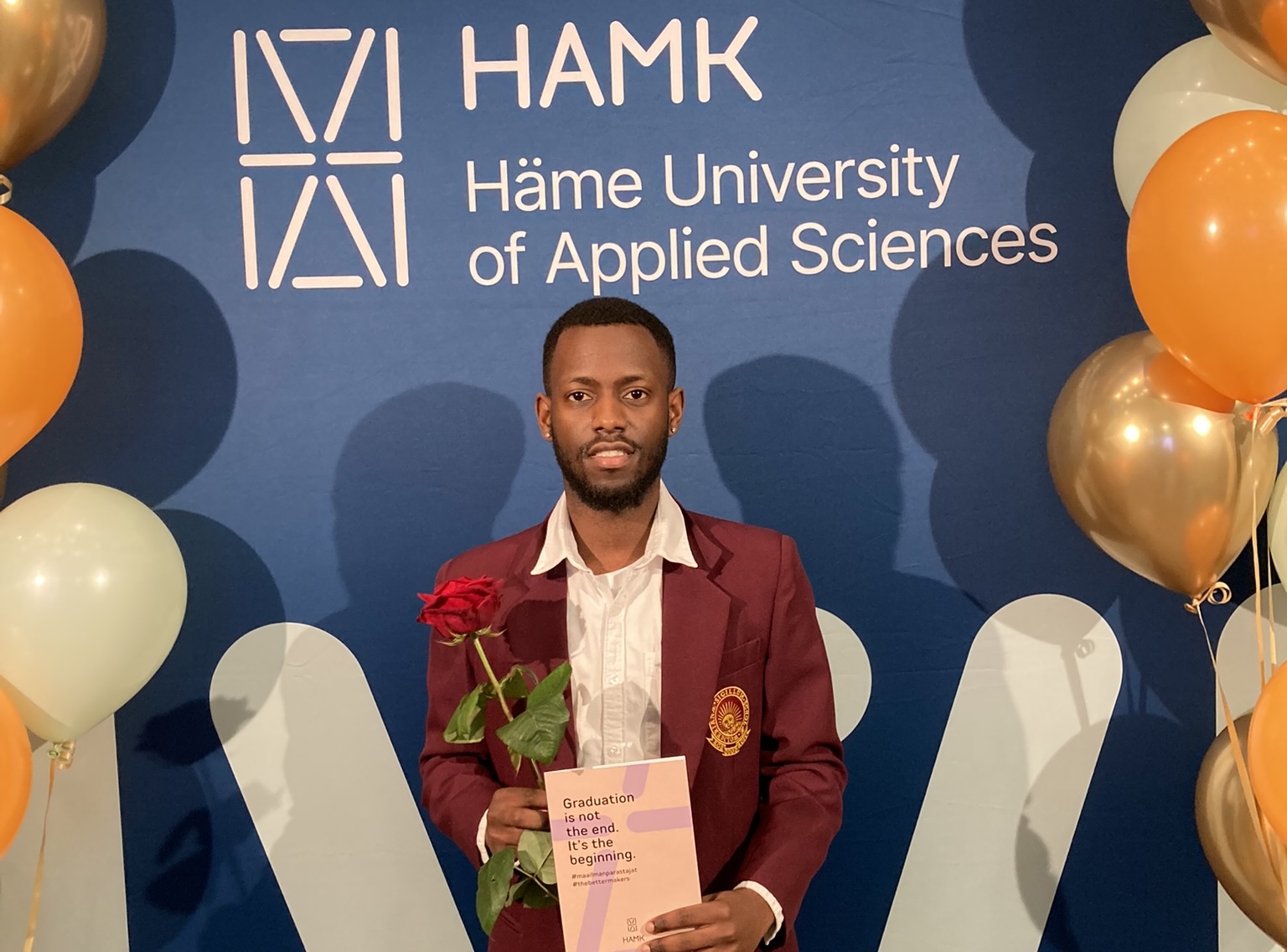
Kelly completed a Bachelor’s degree in Electrical and Automation Engineering from HAMK, where he also became actively involved in university life as a teaching assistant, research assistant and international tutor.
He is now completing a Master’s degree in Smart Grids at Tampere University, focusing on areas including power-system operation, grid digitalisation, distributed energy resources and intelligent control.
At the same time, he is beginning to translate his education into professional experience. Kelly is currently interning with UPM Specialty Papers as an Automation Maintenance Technician.
Five years after arriving in Finland with no established social circle and little idea of what life there would actually be like, he has built an academic, professional and personal foundation in the country.
Should More Jamaicans Consider Finland?
Kelly isn’t trying to sell Finland as a perfect alternative to the United States or Canada.
In fact, that’s part of his advice.
Finland regularly attracts international attention for its quality of life, but Kelly cautions prospective students against allowing rankings or headlines to create unrealistic expectations.
“Don’t have this huge expectation because you see ‘happiest country in the world’,” he advised.
His recommendation is much more practical: research.
Understand the country, programme and application process. Know what documents you will need and get them together early. Understand the climate and culture you’re moving into rather than focusing only on the university.
“Do your research online,” he advised. “Don’t go in blind.”
That’s perhaps the larger lesson from Kelly’s experience.
Watch the full episode of Jamaicans to the World with Daniel Kelly on our YouTube channel, and explore more stories from Jamaicans living, working and studying around the world.
Have a story like Daniel’s to share? We’d love to hear from you. Email us at [email protected].