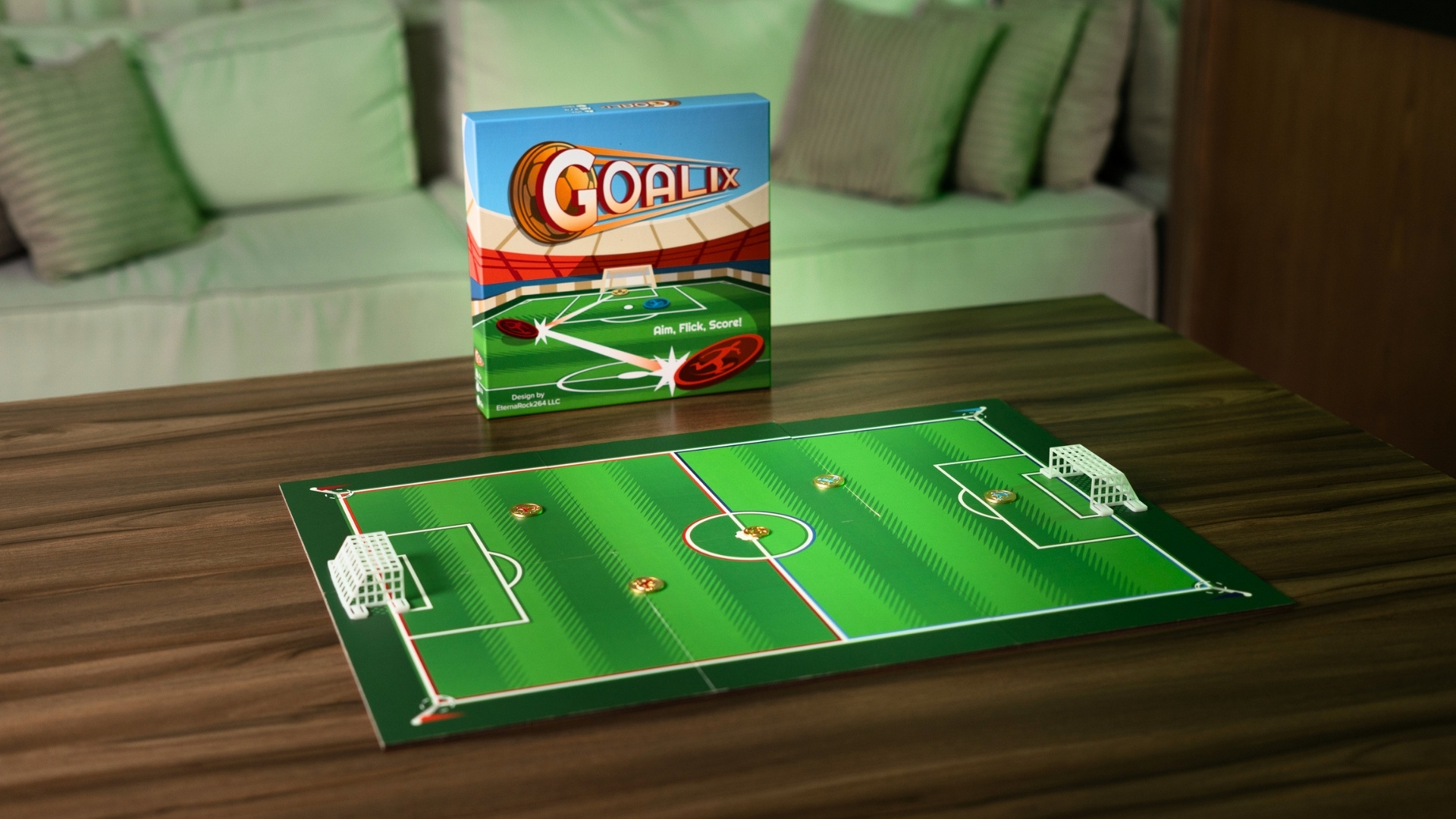
One thing that is undeniable is the ingenuity of Jamaican children at play. With a few everyday knick-knacks and a little free time, they can turn almost anything into a game. Money Football was one such pastime, with schoolboys in particular turning ordinary classroom desks into makeshift football fields.
Jamaican architect-turned-entrepreneur Andrew McFarlane grew up playing Money Football during his high school years. Now, he hopes to introduce the childhood favourite to a new generation through Goalix, a purpose-designed tabletop football game.
Drawing on his professional background in architecture and construction project management, McFarlane has spent the past year and a half developing Goalix into a commercial product. He has launched a Kickstarter campaign to raise funds for its first production run, with ambitions to bring the game to players in Jamaica and around the world.

Meet the Man Behind Goalix
Andrew McFarlane grew up in Mandeville, Manchester, where he attended Knox College High School before moving to Kingston to continue his education at Kingston Technical High School.
After high school, he travelled to the United States to study architecture at Tuskegee University in Alabama. He later earned a master’s degree in Architectural Engineering from Penn State University.
McFarlane went on to spend several years working as an intern architect in Florida before returning to Jamaica, where he established a career in construction project management, a field he continues to work in today.
Despite his professional focus on architecture and construction, McFarlane has always had an entrepreneurial interest.
“Although my professional background is in architecture and project management, I’ve always been interested in creating and developing ideas,” he explained.
That interest led him to establish EternaRock264 LLC, the company behind Goalix, marking his first venture into the tabletop gaming industry.
“Goalix is my first venture into tabletop gaming, and it’s particularly meaningful because it connects my entrepreneurial ambitions with something rooted in my Jamaican childhood.”

Reimagining a Jamaican Schoolboy Favourite
For McFarlane, Money Football was a memorable part of his high school years. The game was essentially a miniature version of football played on a classroom desk or other flat surface, with a makeshift pitch marked out to resemble a football field. Larger coins represented the players, while a smaller coin served as the ball. Using fudge sticks (popsicle sticks), opponents would manoeuvre their player coins to strike the ball and score goals, without touching the ball directly. The concept was simple: aim, flick and score.
What began as a casual game among schoolmates could quickly become a fiercely contested match, complete with the excitement, rivalry and celebrations of a real football game.
“What made it memorable wasn’t simply winning or losing. It was the friendly rivalry, the excitement of scoring a goal, and the laughter and interaction that came with playing,” McFarlane recalled.
Those experiences stayed with him and eventually inspired Goalix, his interpretation of the traditional game.
He began developing Goalix in early 2025, spending approximately 18 months designing, prototyping, testing and refining the concept. Drawing on his background in architecture and project management, he set out to transform the improvised school-day game into a purpose-designed tabletop product.
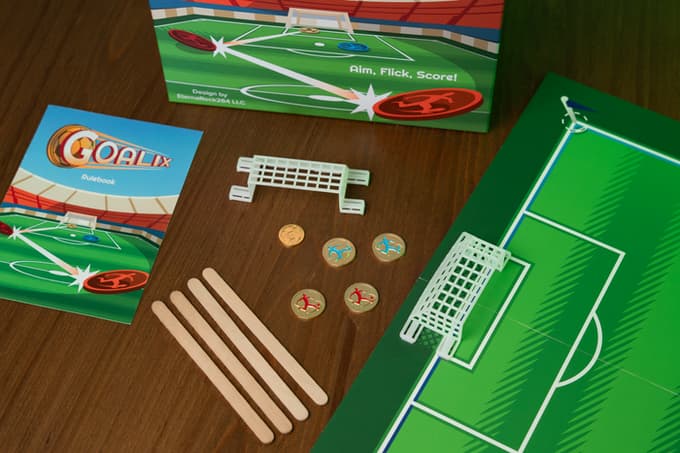
While Money Football relied on players creating their own pitches and improvising with coins and sticks, Goalix comes with a dedicated playing board, goals, player discs, precision flicking sticks and a defined set of rules. The game is designed for two to four players aged 14 and older, with matches expected to last approximately 15 to 20 minutes.
“I didn’t invent Money Football. Goalix is my interpretation of that traditional game, developed into a more structured tabletop experience,” he explained.
Keeping the Game Physical
McFarlane is not alone in recognising the commercial potential of familiar Jamaican pastimes. Jamaican Ludi, developed by Hemiogenic Interactive in collaboration with Willow Tree Studios Collective, is one example of a traditional Jamaican board game being adapted for new audiences through the digital gaming platform Steam.
Goalix, however, takes a different approach. Rather than taking a traditional physical game into the digital space, McFarlane is turning an informal childhood pastime into a purpose-built tabletop product, retaining the physical interaction that was central to the original game.
For McFarlane, that decision was deliberate.
“Today, so much of our entertainment happens through screens. While there’s certainly a place for digital gaming, I believe physical games still offer something special,” he explained.
He recalls that part of the enjoyment of Money Football came from sitting across from friends, competing, celebrating goals and sometimes arguing over whether a shot counted.
“With Goalix, I wanted to preserve that feeling of people coming together, enjoying friendly competition and creating memories through a shared experience.”
The result is a game that relies on players’ skill and precision rather than digital controls, while preserving the face-to-face competition that inspired its creation.
Goalix Kickstarter Campaign
After approximately 18 months of development, prototyping and refinement, McFarlane is now working towards commercial production of Goalix.
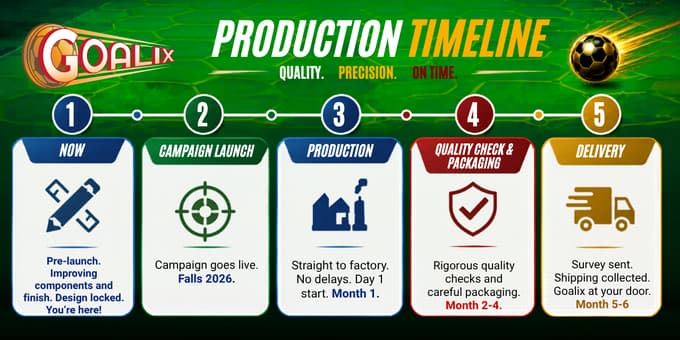
The game is expected to be manufactured in China, where a manufacturing partner will oversee production. However, moving from prototype to a finished product requires funding for manufacturing moulds, game components, packaging and the first batch of units.
To raise the necessary capital, McFarlane launched a Kickstarter crowdfunding campaign on October 13th, 2026, with a target of US$35,233.
At the time of his latest update to Jamaicans.com, the campaign had received US$6,772 in pledges from 31 backers, representing approximately 19 per cent of its fundraising goal.
Kickstarter allows individuals to support creative projects by pledging money in exchange for rewards, which may include receiving the finished product. Unlike purchasing an item already available in stores, backing a Kickstarter project means helping its creator raise the funds needed to bring the idea to market.
The platform operates on an all-or-nothing model, meaning Goalix must reach its fundraising target before pledged funds are collected.
The campaign is initially targeting supporters in the United States and Canada, with the game offered to early backers at a launch price of US$37.
For McFarlane, the campaign represents an important step towards turning a childhood-inspired idea into a commercially available product. It also gives Jamaicans in the diaspora, particularly those who remember playing Money Football, an opportunity to support the venture.
The Goalix Kickstarter campaign ends on November 27th, 2026. Readers interested in learning more about the game or contributing towards its production can visit the official Goalix Kickstarter campaign.
A Jamaican Game with Global Ambitions
Although Goalix is being introduced through an international crowdfunding campaign, McFarlane has not lost sight of the Jamaican childhood experience that inspired it.
His long-term ambition is to establish Goalix as a tabletop game enjoyed across different cultures, backgrounds and generations.
“Although its inspiration comes from Jamaica, I believe the appeal of a simple, competitive, skill-based football game can extend well beyond the Caribbean,” he said.
While the United States and Canada are the initial target markets, McFarlane hopes to eventually make Goalix available in Jamaica and other countries.
For him, commercial success would be particularly meaningful if the game found its way into the same kinds of settings where he first discovered Money Football.
“Personally, one of the most rewarding outcomes would be seeing Goalix played in Jamaican homes, schools and social gatherings, especially knowing that its inspiration came from a game so many of us enjoyed growing up.”
From his early years in Mandeville to his studies in the United States and professional career back in Jamaica, McFarlane has followed a path grounded in design and construction. Goalix now represents a different kind of building project, one that draws on his technical skills, entrepreneurial ambitions and childhood memories.
“Ultimately, I’d love for Goalix to introduce a new generation to the fun, creativity and friendly competition that made Money Football such a memorable part of our childhood.”