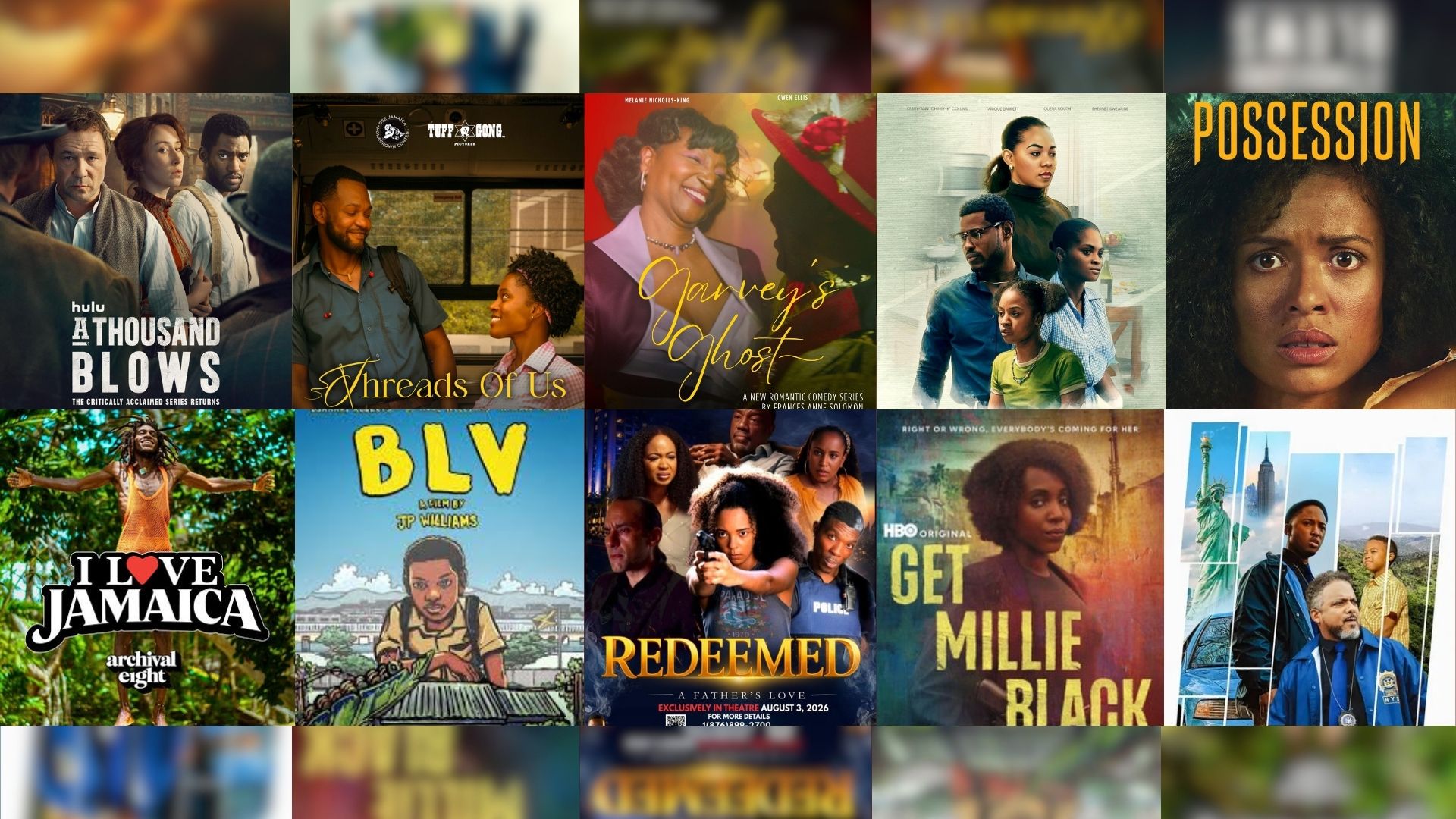
Something interesting has been happening on our screens over the past two years. Across television series, feature films, pilots and shorts, Jamaican stories are showing up in greater variety and in unexpected places.
There is crime noir on the streets of Kingston, Jamaican immigrants fighting their way through Victorian London and Marcus Garvey returning as a duppy in 1950s Toronto. The stories span migration, romance, faith, family, Obeah, colonialism, injustice and everyday Jamaican life.
Just as importantly, more Jamaicans are helping to tell them. From Booker Prize-winning novelist Marlon James creating Get Millie Black to Storm Saulter directing Possession, Jamaican writers, directors, producers and actors are increasingly shaping what appears on screen.
And the work is travelling. These stories are reaching major platforms including HBO, Hulu, Tubi and Sky, earning critical and festival recognition, while locally made productions are finding success at the Jamaican box office.
Jamaica has never lacked great stories or storytellers, with generations of material steeped in our history, culture and people. What feels different now is that more Jamaicans are getting the opportunity to direct the narrative, telling these stories from our own perspective rather than through someone else’s lens. That, in itself, is a game changer for Jamaican storytelling on screen.
Get Millie Black: Kingston Gets Its Own Crime Noir
Created by Jamaican Booker Prize-winning author Marlon James for HBO and Channel 4, Get Millie Black follows Millie-Jean Black, a Jamaican-born former Scotland Yard detective who returns to Kingston and becomes caught up in a missing-person investigation. The five-part series premiered in November 2024.
Filmed primarily in Jamaica, the series presents a lived-in Kingston beyond the familiar images of paradise, violence and poverty, exploring family, sexuality, class, crime and belonging. It stars Tamara Lawrance, Gershwyn Eustache Jnr, Joe Dempsie and Jamaican actress Chyna McQueen, and marked James’s television screenwriting debut.
The series earned strong critical reviews, including a 100 per cent critics’ score on Rotten Tomatoes, showing that a distinctly Jamaican story could hold its own in the world of prestige international crime television.
A Thousand Blows: Jamaican History Before Windrush
If Get Millie Black gives us contemporary Jamaica, A Thousand Blows takes Jamaican characters somewhere we rarely see them: Victorian London.
Created by Peaky Blinders creator Steven Knight and inspired by real historical figures, the series follows Jamaican friends Hezekiah Moscow and Alec Munroe as they arrive in London’s East End and enter the brutal world of bare-knuckle boxing. Malachi Kirby and Francis Lovehall star alongside Stephen Graham and Erin Doherty. The series premiered on Hulu and Disney+ in February 2025.
Beyond the boxing ring, A Thousand Blows pushes Jamaican migration history in Britain beyond the familiar Windrush narrative, reminding audiences that Jamaicans were part of British life long before 1948. It is another example of the expanding possibilities for Jamaican stories and a reminder that the history of the diaspora does not begin where popular memory often places it.
From Yard: From Memoir to the Screen
Migration also sits at the heart of From Yard, based on Jamaican-born playwright and actor David G. Heron’s autobiographical novel Yardie. The drama follows Dave Heron from childhood in Jamaica to his turbulent young adulthood in New York.
Heron serves as executive producer and co-writer, Leland Benford directs, and Jamaican actors Shevrado Oliver and Glen “Titus” Campbell are among the cast. After premiering in Jamaica in 2023, the award-winning pilot reached a much wider audience when it became available internationally on Tubi in August 2025.
From Yard represents another important part of the Jamaican storytelling ecosystem. Not every production will arrive with HBO or Disney behind it, and streaming offers independent Jamaican and diaspora productions another route to reach audiences well beyond their initial screenings.
Garvey’s Ghost: Marcus Garvey Returns as a Duppy
How do you bring Marcus Garvey’s teachings to a new generation? Apparently, through his duppy.
Created and directed by Caribbean-Canadian filmmaker Frances-Anne Solomon, Garvey’s Ghost follows a young Jamaican arriving in 1950s Toronto and finding community through the Universal Negro Improvement Association. Jamaican comedian and actor Owen “Blakka” Ellis plays Garvey, who returns as a ghost, alongside a cast that includes Richard Walters, Melanie Nicholls-King and Peter Williams.
The series has travelled through international screenings, including the Pan African Film & Arts Festival in Los Angeles. Beneath the humour is a serious idea: Jamaican history does not have to be preserved only through documentaries, textbooks and solemn biopics. It can also be reimagined through comedy and the supernatural for audiences who may otherwise never seek it out.
Possession: A Past That Refuses to Stay Buried
In Possession, the supernatural becomes a vehicle for confronting colonial history.
Directed by acclaimed Jamaican filmmaker Storm Saulter, the five-part thriller follows Claudia, a lawyer who travels to Jamaica to challenge an inheritance claim involving a wealthy British family and their former Jamaican plantation. What begins as a legal dispute becomes considerably darker as the past begins haunting the present. Gugu Mbatha-Raw stars alongside Jonny Lee Miller and Jamaican actor Sheldon Shepherd.
Released on Sky and NOW in August 2026, Possession uses supernatural storytelling to confront colonialism, slavery and inherited privilege. Having Saulter, the filmmaker behind Better Mus’ Come and Sprinter, at the helm of a major international production deeply connected to Jamaica is also significant. And it points to another interesting development in Jamaican storytelling: the duppy has entered the chat.
Stew Peas: Obeah and the Things We Don’t Talk About
That supernatural thread runs straight into Sosiessia Nixon-Kelly’s Stew Peas, although this time the story is being told entirely from within Jamaica.
Written, directed and produced by Nixon-Kelly, the psychological thriller draws on the Jamaican belief that a woman can use food to “tie” a man through Obeah. But that provocative premise opens the door to much bigger questions around infidelity, gender expectations, free will, class, family and the uncomfortable place Obeah continues to occupy in Jamaican culture.
The locally made film premiered in June 2026 and opened in Jamaican cinemas the following month, finishing its opening weekend as the country’s second-highest-performing film. Its success matters because Stew Peas is resolutely home-grown, showing that there is space not only for international studios to tell stories about Jamaica, but for Jamaican filmmakers to tell their own stories and find an audience for them.
Threads of Us: A Love Story With Something to Say
Threads of Us takes us in another direction entirely.
Written by Jamaican filmmaker Donisha Prendergast and directed by Mykal Cushnie, the film stars Sevana and Shomari Downer as Danielle and Malcolm, two ordinary Jamaicans whose developing relationship is disrupted when Malcolm is accused of a crime. Their story explores injustice and resilience while remaining grounded in the everyday rhythms of Jamaican life.
The independent feature, made with an all-Caribbean cast and crew, premiered at the Skylark Film Festival in Negril in October 2025. It also widens the picture of what Jamaican cinema can look like. Not every Jamaican story has to explain Jamaica to outsiders. Sometimes it can simply follow Jamaicans falling in love, going to work, riding the bus and confronting the systems around them.
BLV: The Next Generation
Perhaps one of the most fitting projects in this conversation is BLV, a short film written and directed by young Jamaican filmmaker JP Williams about a Jamaican boy who dreams of becoming a filmmaker despite his father’s opposition.
There is something almost meta about that premise at this particular moment. As Jamaican stories appear on major global networks and streaming platforms, BLV turns the camera towards a young Jamaican imagining himself as one of the people who gets to create those stories. Filmed in Jamaica, the short has also travelled through the international film festival circuit.
BLV represents another crucial part of this moment: the pipeline. The future of Jamaican storytelling cannot depend on a handful of established names. It requires young writers, directors, actors, cinematographers, editors and producers believing that filmmaking is something they can actually do from Jamaica.
Redeemed: A Father’s Love – A Surprisingly Convincing Accent
One welcome side effect of this proliferation of Jamaican stories, with more Jamaicans involved in the writing, production and acting, is that the accents have improved dramatically. Case in point: Malik Yoba in Redeemed: A Father’s Love.
The faith-based crime drama explores betrayal, identity, forgiveness and redemption through a family torn apart by a childhood kidnapping. Yoba leads a cast that includes Jacinth Headlam, Cornelius Grant, Julie Mango, Prince Saj and Safaree Samuels. The film had its Jamaican premiere in August 2026.
Redeemed also adds another genre to the growing mix of Jamaican stories on screen. Faith-based family drama may seem worlds apart from the crime noir of Get Millie Black or the supernatural themes of Possession, but that is precisely the point: there should never be just one type of Jamaican story.
Beyond Obeah, Slavery and the Familiar
It would be tempting to declare that Jamaican film has arrived, but these productions come from very different ecosystems. Some are backed by major international networks and streaming platforms, while others rely on independent producers, festivals and filmmakers determined to get their work made and seen. What is encouraging across these different spaces, however, is the growing presence of Jamaican filmmakers, writers, actors and other creatives, not simply as subjects of these stories but as the people helping to shape and tell them.
Equally encouraging is the growing breadth and depth of the stories themselves. But there is still much more of Jamaica left to tell. Obeah, slavery and colonialism are important parts of our history and culture, but they should not become the next shorthand for Jamaican storytelling simply because they are intriguing or marketable to international audiences. God knows, we have enough slavery stories.
There are generations of Jamaican experiences, communities, traditions, industries, subcultures and everyday lives still largely absent from the screen. The hope is that this moment creates room for stories that dig deeper into the full complexity of Jamaican life, including the parts that may not immediately appear exotic, dramatic or easily packaged for audiences abroad.
The challenge now is turning these individual successes into something sustainable, where Jamaican filmmakers can consistently finance, produce, distribute and profit from their work while creating opportunities for the next generation.
Jamaica has no shortage of stories. And increasingly, the world is willing to watch them.